
- 科目一考试
- 顺序练习
- 随机练习
- 强化练习
- 模拟考试
- 科目四考试
- 顺序练习
- 随机练习
- 强化练习
- 模拟考试
- 外国语言版题库
- 英语题库
- 德语题库
- 韩语题库
- 日语题库
- 俄语题库
- 法语题库
- 西班牙语题库
- 阿拉伯语题库
- 摩托车英文题
吉林考驾照科目四有英文版
-
1、After a motor vehicle falls into water, the driver won't be able to open the side doors or windows to escape until water nearly fills up the compartment.
Answer:Y
2、When driving on a foggy day, what kind of lamps should the driver turn on?
A、Fog lamp and hazard lamp
B、Fog lamp and indicator
C、Fog lamp and high-beam
D、Fog lamp and low-beam
Answer:A
3、How should lamps be used when setting off in this situation?

A、Turn on the high-beam
B、Turn on the left indicator only
C、Turn on the left indicator and low-beam
D、Turn on hazard lamp
Answer:C
4、What should the driver do when seeing these hand signals?

A、Go straight and pass through the intersection
B、Stop in front of the stop-line and wait
C、Turn left at the intersection
D、Drive at a lower speed at the intersection
Answer:C
5、When fixing the unexposed bones in position, it is necessary to exceed the upper and lower joints of the wounded body part.
Answer:Y
6、The sign on the right indicates a T-shaped intersection head.

Answer:N
7、When driving, besides paying attention to keeping a safe distance from the vehicle in front, drivers should also be prudent when braking so as to avoid a rear-end collision caused by a vehicle behind.
Answer:Y
8、Sideslip happens most easily on which one of the following road surfaces?
A、Dry concrete road
B、Road surface at the beginning of rain
C、Damp concrete road surface
D、Road in heavy rain
Answer:B
9、What should the driver do when seeing these hand signals?

A、Go straight and pass through the intersection
B、Stop and wait
C、Turn right at the intersection
D、Turn left at the intersection
Answer:B
10、When a collision occurs on the passenger seat side or the impact is relatively small, which of the following methods is incorrect?
A、Firmly holding the steering wheel
B、Stretching both feet forward
C、Jumping out of the vehicle from one side
D、Leaning body backwards against the seat
Answer:C
11、The sign on the right indicates a bypass flow intersection ahead.

Answer:N
12、When a motor vehicle breaks down and cannot be moved away from the emergency lane or the road shoulder, the driver and all passengers should get off the vehicle and wait on the road side instead of leaving the expressway.
Answer:N
13、When a motor vehicle turns left at this intersection the driver should change to the left lane in advance by the guide arrow.
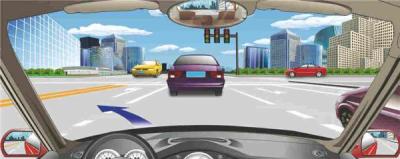
Answer:Y
14、The sign on the left indicates U-turn is allowed here.

Answer:Y
15、When the tire pressure is too low, what will happen if the tire changes its shape in waves and increases in temperature due to fast movement?
A、Unstable tire pressure
B、Even lower tire pressure
C、Driving resistance increases
D、Tire burst
Answer:D
16、Which one of the following statements is correct in this situation?

A、Vehicles are prohibited from passing in the lanes on either side
B、Move into the lane on either side at a reduced speed
C、Move into the lane on the right side
D、Move into the lane on either side at an increased speed
Answer:A
17、The sign on the right warns of no passing due to collapse on the road ahead.

Answer:N
18、When there is a braking failure on a downhill road the driver should change the gear to one position or two positions lower, and control the speed by taking advantage of the braking role of the engine.
Answer:Y
19、The sign on the right warns of a winding road to the left ahead.

Answer:N
20、How many kinds of law-breaking acts are displayed in flash 4?

A、One
B、Two
C、Three
D、Four
Answer:C
21、The guide arrow on the road surface of this lane indicates that there is an intersection on the right side of the road.

Answer:N
22、Before driving, it is necessary to check whether the cooling liquid, engine oil and fuel oil, are leaking.
Answer:Y
23、The sign on the right warns that there are vehicles converging into the intersection on the right.

Answer:Y
24、Under such circumstances, what should be done by motor vehicle drivers in order to maintain safe driving?

A、Sound the horn or turn on the headlamps
B、Reduce speed or drive on the right side
C、Keep to the central line as best as possible
D、Drive on the left side of the road
Answer:B
25、What should be done to keep safe when a motor vehicle driver is overtaking in this condition?

A、Reducing speed and keeping a safe distance
B、Continuously sounding the horn to indicate the vehicle in front
C、Accelerating to pass while keeping a certain distance
D、Overtaking by occupying the opposite lane
Answer:A
26、As shown in this picture, the intersection guide line is designed to help drivers make turns.

Answer:Y
27、This sign indicates the traffic broadcast and radio television channel of highway.

Answer:N
28、After speeding up to more than 60 km/hour, a motor vehicle driver may drive onto the driving lane directly.
Answer:N
29、The sign on the right side warns of crosswind on the mountain pass ahead.

Answer:Y
30、What should the driver do upon finding that one ofthe right tires is leaking while driving?
A、Brake swiftly to slow down
B、Brake slowly to slow down
C、Turn to the left side swiftly
D、Apply emergency braking
Answer:B
31、Which of the following acts are prohibited when passing through a tunnel?
A、Overtaking
B、Stopping
C、Making a U-turn
D、Reversing
Answer:ABCD
32、Under such circumstance at an intersection. motor vehicle drivers should be prepared to stop and yieldat any time.

Answer:Y
33、The right-front sign indicates a time-regulated pedestrian area.

Answer:Y
34、Mr Li drove a large bus with 21 passengers( capacity 35 people). He found the braking system was abnormal on the way but failed to repair it. When running on the Shuangdao Haiwan Bridge at a speed of 50 kilometers per hour(speed limit 40 km/h), the bus fell into the sea due to a braking system failure, killing 13 people and injuring 8. What's the main illegal act committed by Mr Li?
A、Speeding
B、Fatigued drivin
C、Carrying more passengers than permitted
D、Driving a motor vehicle with potential safety hazard
Answer:AD
35、When the motor vehicle stops on an uphill section, how should the driver use the foot brake?
A、Earlier than on a level road
B、Later than on a level road
C、As timely as on a level road
D、Strongly depress the foot brake pedal
Answer:B
36、When this signal is constantly flashing, how should a driver react?

A、Speed up as soon as possible
B、Pull over and wait
C、Observe the traffic situation around to make sure of safe driving
D、Refrain from passing
Answer:C
37、When the engine suddenly stalls on the road, what should the driver do?
A、Stop the vehicle and overhaul it immediately
B、Immediately turn on the hazard lamps
C、Move the vehicle to a place where it will not obstruct the traffic flow
D、Set up a breakdown warning sign
Answer:BCD
38、As shown in this picture, the vehicles intending to turn left are not allowed to drive into left-turn waiting area directly to wait for green light.

Answer:N
39、The guide arrow on the road surface of this lane indicates that drivers are only permitted to continue straight at the intersection ahead.

Answer:N
40、The sign on the right indicates a section for ascertaining the distance between the vehicles 200 meters ahead.

Answer:Y
41、How many kinds of law-breaking acts are displayed in flash 8?

A、One
B、Two
C、Three
D、Four
Answer:B
42、The sign on the right is an advance announcement of the highway destination.

Answer:N
43、Mr Peng drove a heavy semi-trailer tractor with 37.7 tons of cargo(capacity 25 tons). When descending a slope on the Daguang Expressway, the tractor had a rear-end collision with Mr. Li's heavy dump truck ( carrying 3.17 cubes of loess and 24 passengers in the container)occupying the emergency lane. As a result of this accident, 16 people were killed and 13 injured What are the main illegal acts in this case?
A、Mr Peng exceeded the speed limit
B、Mr. Peng's tractor carried more cargo than limited
C、Mr Li illegally drove in the emergency lane
D、Mr. Li's truck illegally carried passengers in the container
Answer:BCD
44、Crossing the broken white line on the right edge of the road is allowed.

Answer:Y
45、Under such circumstances, motor vehicle drivers should stop and yield

Answer:Y
46、The motor vehicle equipped with ABS may sideslip during an emergency brake.
Answer:Y
47、Which of the following measures is correct for rescuing a person sustaining full-body burns?
A、Cover the fire with sandy soil
B、Spray cool water to his body
C、Put out the fire by extinguisher
D、Help to remove the burning clothes
Answer:B
48、Mr. Tao drove a midsize bus with 33 passengers. At the spot of 163 kilometers on the South Xuping Expressway, the bus clashed at a speed of 120 kilometers per hour with Mr. Ans minibus parked without any warning signs on the inside lane, due to breakdown after an accident. The midsize bus overturned after collided with the guardrail on the right-hand side. As a result of the accident, 16 people were killed and 15 injured. What are the main illega acts of the two drivers?
A、Mr. Tao carried more passengers than permitted
B、Mr. Tao exceeded speed limit
C、Mr. An failed to place any warning signs in accordance with relevant stipulations
D、Mr. An was illegally parked
Answer:ABC
49、Under such circumstances at a congested intersection, what should motor vehicle drivers do?

A、Force the vehicle to go back to its original lane
B、Closely follow the vehicle in front and refuse to yield
C、Politely yield and pass through
D、Sound the horn and turn on the head lamps
Answer:C
50、Which of the following is an inflammable solid material?
A、Matches
B、Gun powder
C、Calcium carbide
D、Explosives
Answer:A
- 吉林考驾照科目四有英文版 相关内容
- 内蒙古驾考科目一英语版书 山西英文驾考app 外国驾照考试视频大全图片 内蒙古驾考科目四英语 黑龙江外国人考驾照科目一 内蒙古驾考科目四英语版书 甘肃科目四英文版模拟 贵州英语c1科目四考试 云南2025科目一考试英文 driving in china 青海2025科目四考试英文 宁夏外国人考驾照科目四 山东驾照考试科目一英文版 驾照科目一英文版题库 山东驾考科目四英文版题库 江苏外国人考驾照科目一
Copyright © 2025 驾考 版权所有