
- 科目一考试
- 顺序练习
- 随机练习
- 强化练习
- 模拟考试
- 科目四考试
- 顺序练习
- 随机练习
- 强化练习
- 模拟考试
- 外国语言版题库
- 英语题库
- 德语题库
- 韩语题库
- 日语题库
- 俄语题库
- 法语题库
- 西班牙语题库
- 阿拉伯语题库
- 摩托车英文题
广东外国人考驾照科目四
-
1、After a motor vehicle falls into water, the driver won't be able to open the side doors or windows to escape until water nearly fills up the compartment.
Answer:Y
2、Which of the following measures should be taken first when rescuing a wounded person suffering blood loss?
A、Observe
B、Dress the wounds
C、Stop bleeding
D、Inquire
Answer:C
3、When the windscreen of a motor vehicle on the highway is cracked by flying rocks or debris which makes visibility poor, the driver should reduce speed gradually, turn on the hazardlamps, drive to a place where it will not obstruct the traffic flow and stop there.
Answer:Y
4、In rain, the most effective way to avoid the danger arising from "water slide" is to drive at high speed
Answer:N
5、The sign on the right indicates a one-kilometer distance from ETC toll station ahead.

Answer:N
6、Sideslip happens most easily on which one of the following road surfaces?
A、Dry concrete road
B、Road surface at the beginning of rain
C、Damp concrete road surface
D、Road in heavy rain
Answer:B
7、Under such circumstances, motor vehicles are not allowed to overtake.

Answer:Y
8、When driving a motor vehicle equipped with power steering, the driver should firmly hold the steering wheel and drive slowly if he/she suddenly finds that steering is difficult.
Answer:N
9、Drivers may temporarily cross these central solid double yellow lines when overtaking.

Answer:N
10、How to pass the intersection when running straight

A、turn on the hazard lights and pass
B、directly speed up and pass straight
C、yield to the vehicle from the right road
D、yield to the vehicle from the left road
Answer:C
11、Drivers should drive at a lower speed when traffic police give these hand signals.

Answer:Y
12、The diamond-shaped sign on the road indicates a crosswalk on the road ahead.

Answer:Y
13、The sign on the right warns of a village 200 meters ahead.

Answer:Y
14、As shown in the flash, what should the motor vehicle driver do when encountering this situation?

A、Reserve a safe crosswise distance and cut speed
B、Keep a normal speed
C、Use the emergency brake when approaching
D、Speed up and pass rapidly
Answer:A
15、Under such circumstances, what should be done by the motor vehicle driver?

A、Overtaking the vehicle in front on its left
B、Overtaking by occupying the opposite lane
C、Overtaking the vehicle in front on its right
D、Following the vehicle in front
Answer:D
16、As shown in this picture, the intersection guide line is designed to help drivers make turns.

Answer:Y
17、How should motor vehicle drivers make a U-turn at the intersection ahead?

A、Make a U-turn in the waiting area for turning left
B、Make a U-turn at the broken line area of the Intersection
C、Wait until the left-turn indicator is on
D、Wait until the straight-going signal is on
Answer:B
18、Under such circumstances, what should be done by the motor vehicle driver who has been overtaken?

A、Sounding the horn to warn the vehicle that overtook
B、Reducing speed or pulling over by the right side
C、Protesting by turning on the high-beam
D、Catching up with and overtaking the vehicle that overtook, and offering admonitions
Answer:B
19、When approaching the turning point of a road, in which of the following ways will motor vehicle drivers easily cause a traffic accident?
A、Driving ahead by occupying the opposite lane
B、Turning the steering wheel quickly when passing through the curve
C、Not reducing speed until driving onto the curve
D、Driving by the right side
Answer:ABC
20、Which of the following is a bad habit when changing lanes?
A、Turning on the indicator in advance
B、Observing closely before changing a lane
C、Change lanes at will
D、Not obstructing the passing of other normally moving vehicles
Answer:C
21、Under the circumstances shown in the flash, what should be done by the vehicle in front?

A、Reduce speed swiftly or apply emergency brake
B、Drive at a higher speed after giving a proper space
C、Reduce speed and yield by the right side of the road
D、Drive at a higher speed by the right side of the road
Answer:C
22、The white solid line on the right side of the road indicates the boundary of a driving lane and crosswalk.

Answer:N
23、When rescuing a person sustaining full-body burns the rescue personnel may spray cool water to his body to put out the fire.
Answer:Y
24、When there is bleeding at the bone fracture of a wounded person, the first thing to do is to fix the wounded part in position, then stop the bleeding and dress the wound.
Answer:N
25、How many kinds of law-breaking acts are displayed in flash 2?

A、One
B、Two
C、Three
D、Four
Answer:B
26、The sign on the right indicates a 2-kilometer distance from the Donglushan Service Area on the highway.

Answer:Y
27、After a traffic accident, what is the most effective measure to prevent secondary accidents?
A、Evacuate all passengers
B、Turn on the hazard lamps
C、Mark the original place of the injured persons
D、Properly place the danger warning sign
Answer:ABD
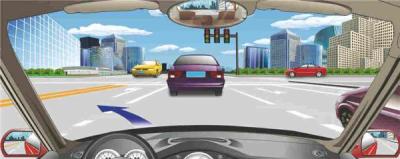
28、When a motor vehicle turns left at this intersection the driver should change to the left lane in advance by the guide arrow.
Answer:Y
29、Under such circumstances, what should be done by a motor vehicle driver in order to yield out of courtesy?

A、Driving at a higher speed
B、Closely following the vehicle in front
C、Driving at a higher speed by the right side
D、Driving at a lower speed by the right side
Answer:D
30、The sign on the right warns to keep a safe distance on the road ahead.

Answer:N
31、Mr Li drove a large bus with 21 passengers( capacity 35 people). He found the braking system was abnormal on the way but failed to repair it. When running on the Shuangdao Haiwan Bridge at a speed of 50 kilometers per hour(speed limit 40 km/h), the bus fell into the sea due to a braking system failure, killing 13 people and injuring 8. What's the main illegal act committed by Mr Li?
A、Speeding
B、Fatigued drivin
C、Carrying more passengers than permitted
D、Driving a motor vehicle with potential safety hazard
Answer:AD
32、When an erosive material catches fire, it should not be put out with water cannon.
Answer:Y
33、When driving on an expressway, drivers should not frequently change lanes.
Answer:Y
34、When running on an expressway with three lanes in each direction, which one of the following lanes is not appropriate for the motor vehicle to use if its speed ranges between 90 kilometers per hour and 110 kilometers per hour?
A、The far left lane
B、The middle lane
C、The far right lane
D、Any lane
Answer:A
35、How should lamps be used when motor vehicle drivers pass through a two-way tunnel?
A、Turn on the hazard lamps
B、Turn on the high-beam
C、Turn on the fog lamp
D、Turn on the low-beam
Answer:D
36、It is an illegal act for the driver to make calls while driving.
Answer:Y
37、When driving on a snowy day, drivers should follow the tracks on the road before them.
Answer:Y
38、When driving in a heavy rain, drivers should contro their speed to prevent their vehicles from sliding.
Answer:Y
39、Motor vehicle drivers are allowed to overtake on this road section.

Answer:N
40、The sign in front is an advance announcement of the directions led by the interchange.

Answer:Y
41、What should the driver pay attention to in this situation?

A、Pedestrians passing behind the vehicle
B、Pedestrians passing in front of the vehicle
C、Public buses suddenly reversing
D、Public buses suddenly setting off
Answer:B
42、At 3: 40 a.m. one day, Mr. Sun drove a large bus with 54 passengers(capacity 55 people). At the spot of 229 kilometers mark by 300 meters on Suiyue Expressway, the bus had a rear-end collision with a heavy semi-trailer driven by Mr. Li when passengers were getting off from the bus. As a result of the accident, 26 people were killed and 29 injured. According to the investigation afterwards, Mr. Li had been driving the bus since he left the place of departure at 6 p.m. the day before without any rest. What are the main illegal acts of the two drivers?
A、Mr. Sun illegally parked
B、Mr. Sun carried more passengers than permitted
C、Mr. Li exceeded speed limit
D、Mr. Li kept driving when tired
Answer:AD
43、Motor vehicle drivers don't need to fasten their seatbelt
Answer:N
44、What caused this drivers death in an accident?

A、Failing to fasten seatbelt
B、Positioned too close to the steering wheel
C、Failing to hold the steering wheel
D、Failing to turn on SRS
Answer:A
45、The motor vehicle should slow down and pass slowly in this situation.

Answer:Y
46、The sign on the right indicates that the speed limit of 40km/hour is lifted on the road ahead.

Answer:Y
47、Motor vehicles are permitted to follow the guidance of the arrow in this picture and enter the lane of an expressway.

Answer:N
48、When rescuing a wounded person who has been poisoned by toxic gas, the first measure is to send him/her to a place with fresh air so that he/she will not continue to be poisoned.
Answer:Y
49、When a motor vehicle skids sideways on a muddy road, the driver should turn the steering wheel in the direction of the rear wheel skidding to properly adjust the direction.
Answer:Y
50、When braking, the steering will become impossible if the front wheels are blocked
Answer:Y
- 广东外国人考驾照科目四 相关内容
- 陕西科目四英文版 广西英文考驾照用语 湖北科目四考试英文版 江西驾考科目一英文版题库 甘肃外国人考驾照科目一 江西科目四英文版 黑龙江科目一有英文版吗 内蒙古2025科目四考试英文 重庆2025科目四考试英文 辽宁驾考科目一英语版PDF题库 黑龙江只认识英文可以考科目一吗 老外考驾照需要准备什么材料和证件 湖南2025科目四考题英文版 新疆驾照考试科目一英文版 湖北外国人考驾照科目四 河南驾考英语
Copyright © 2025 驾考 版权所有