
- 科目一考试
- 顺序练习
- 随机练习
- 强化练习
- 模拟考试
- 科目四考试
- 顺序练习
- 随机练习
- 强化练习
- 模拟考试
- 外国语言版题库
- 英语题库
- 德语题库
- 韩语题库
- 日语题库
- 俄语题库
- 法语题库
- 西班牙语题库
- 阿拉伯语题库
- 摩托车英文题
广西科目四英文版题目
-
1、How will the adhesive force of road change when speed increases on a damp and slippery road?
A、Increase sharply
B、increase gradually
C、decrease sharply
D、No change
Answer:C
2、The sign on the right warns of children on the section ahead.

Answer:N
3、The driver may turn right directly at this intersection.

Answer:N
4、What should the driver do when a motor vehicle encounters this situation on a mountain road?

A、Stick to respective lanes and speed up to approach each other
B、Drive close to the central line of the road
C、Retain the normal speed
D、Slow down
Answer:D
5、The sign in front indicates a 2-kilometer distance from the destination of the highway ahead.

Answer:Y
6、Drivers may cross these lane-dividing lines to change lanes in the same direction.

Answer:N
7、When the engine suddenly stalls on the road, what should the driver do?
A、Stop the vehicle and overhaul it immediately
B、Immediately turn on the hazard lamps
C、Move the vehicle to a place where it will not obstruct the traffic flow
D、Set up a breakdown warning sign
Answer:BCD
8、When a motor vehicle turns left at this intersection the driver should change to the left lane in advance by the guide arrow.
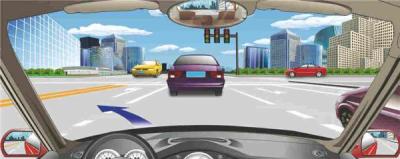
Answer:Y
9、If a motor vehicle breaks down or causes a traffic accident on the expressway and cannot run normally the vehicle may be towed by any accompanying motor vehicles.
Answer:N
10、Under the circumstances shown in the flash, what should the driver do?

A、Find a chance to overtake the vehicle in front
B、Weave through motor vehicles ahead and pass
C、Reduce speed, stop, and wait in line
D、Sound the horn to urge vehicles in front
Answer:C
11、When a motor vehicle leaves an expressway, which of the following lamp should be turned on?
A、The left-turn indicator
B、The right-turn indicator
C、The hazard warning lamp
D、The headlamp
Answer:B
12、What should the driver pay attention to when the motor vehicle passes a school?
A、Observe the traffic signs and markings
B、Slow down and pass slowly
C、Prohibited from sounding the horn
D、Pass rapidly
Answer:ABC
13、When extinguishing a fire, the driver should refrain from breathing through mouth or crying loudly Otherwise, the fire and smoke will scorch the upper respiratory tract.
Answer:Y
14、When approaching each other at night in this situation, drivers should watch for the danger where the two motor vehicles headlamps meet(the sight dead zone).
Answer:Y
15、Mr. Wu drove a large bus with 33 passengers (capacity 22 people). At the spot of 7 kilometers mark by 300 meters on the No 163 County Road, the bus lost control and fell into a ravine. As a result of the accident, 10 people were killed and 21 injured. In accordance with the alcohol test after the accident the blood alcohol content of Mr Wu was 26 milligram per milliliter. What's the main illegal act committed by Mr Wu?
A、Speeding
B、Carrying more passengers than permitted
C、Fatigued driving
D、Driving after drinking
Answer:BD
16、The sign on the right warns that there are vehicles converging into the intersection on the right.

Answer:Y
17、Motor vehicle drivers may make a U-turn in the broken line area as long as it will not affect the normal traffic flow.

Answer:Y
18、The road marking on the right lane indicates that drivers may temporarily borrow the special lane for buses.

Answer:N
19、How should lamps be used when motor vehicle drivers pass through a two-way tunnel?
A、Turn on the hazard lamps
B、Turn on the high-beam
C、Turn on the fog lamp
D、Turn on the low-beam
Answer:D
20、When passing this mountainous road, motor vehicle drivers should drive along the center of the road.

Answer:N
21、Which one of the following is the safest way to pass the oncoming vehicle on this road?

A、Driving along the central line
B、Driving with headlamp on
C、Yielding by the right side of the road
D、Yielding by the left side of the oncoming vehicle
Answer:C
22、The driver may not change lanes when the motor vehicle turns right at this intersection.

Answer:N
23、When such circumstances happen suddenly, what should the driver do?

A、Reduce speed or stop to yield
B、Bypass in front of the pedestrians
C、Continuously sound the horn to alert the pedestrians
D、Bypass from behind the pedestrians
Answer:A
24、What should the driver do when the motor vehicle counters this situation?

A、Sound the horn continuously to warn
B、Speed up and bypass from the front
C、Slow down when encountering any risks
D、Slow down voluntarily and yield
Answer:D
25、When driving on a road covered with ice and snow, drivers tend to encounter glare caused by reflection of light rays from the road surface.
Answer:Y
26、Which of the following materials should not be used to stop bleeding?
A、Bandage
B、Sling
C、Tourniquet
D、Hemp rope
Answer:D
27、The sign on the right indicates to stop and yield for oncoming vehicles approaching on the road ahead.

Answer:N
28、The cross-hatched marking indicates an area where vehicle drivers are allowed to stop and wait.

Answer:N
29、The sign above the tunnel indicates a height limit of 3.5 meters on the road ahead.

Answer:Y
30、The sign in front indicates a one-kilometer distance from the next left exit.

Answer:N
31、What should the driver do when the motor vehicle encounters this situation in front of a school?

A、Bypass before the queue
B、Slow down and pass slowl
C、Stop promptly and yield
D、Go through in the spaces between the queues
Answer:C
32、When a motor vehicle stops in snow, which lamp should be turned on?
A、Front and rear fog lamps, clearance lamp and rear position lamp
B、Reverse lamp, clearance lamp and rear position lamp
C、Headlamp, clearance lamp and rear position lamp
D、Hazard lamps, clearance lamp and rear position lamp
Answer:D
33、Motor vehicle drivers are allowed to overtake on this road section.

Answer:N
34、Crossing the broken white line on the right edge of the road is allowed.

Answer:Y
35、The sign on the right indicates an ETC lane at toll station ahead.

Answer:Y
36、How should lamps be used by the motor vehicle driver who follows a vehicle on a road section where he street light condition is good?
A、Turn off the headlamp
B、Use high-beam
C、Turn off all lamps
D、Use low-beam
Answer:D
37、The sign on the right warns to keep a safe distance on the road ahead.

Answer:N
38、What should the motor vehicle driver do when the motor vehicle encounters the crosswalk in thissituation?

A、Slow down and pass
B、Speed up and pass
C、Sound the horn and pass
D、Stop immediately
Answer:A
39、When a motor vehicle breaks down and has to be stopped on the highway, what should the driver do?
A、Set up a breakdown warning sign 150 meters behind the vehicle
B、Set up a breakdown warning sign 100 meters behind the vehicle
C、If it happens at night, turn on the clearance lamp and rear position lamp
D、Turn on the hazard lamps
Answer:ACD
40、The sign in front gives information about the direction of road exits.

Answer:Y
41、The sign on the right indicates that the speed limit of 40km/hour is lifted on the road ahead.

Answer:N
42、When parking temporarily in this situation, motor vehicle drivers are allowed to turn the steering wheel right to avoid sliding.

Answer:Y
43、The slanted filled-in yellow marking in the middle of the road warns that there is a stationary obstacle ahead.

Answer:Y
44、When a motor vehicle passes over an inundated road, what should the driver do for safe driving?
A、Slow down and drive with special care
B、Speed up and pass rapidly
C、Maintain a normal speed and pass through
D、Change to a low gear and speed up to pass
Answer:A
45、What kind of harmful effect will be brought about by continuously using the foot brake on a long downhill road?
A、Shorten the engine's service life
B、Make the driver feel tired
C、Easily cause the vehicle to overturn
D、Reduce the braking efficiency
Answer:D
46、When the motor vehicle encounters a crosswalk in this situation, the driver may speed up and pass rapidly.

Answer:N
47、The broken yellow line in the center of the road indicates that overtaking by crossing the line is permitted in safe situations.

Answer:Y
48、The guide arrow on the road surface of this lane indicates that only left and right turns are permitted on the lanes ahead.

Answer:Y
49、The sign on the right indicates the road width ahead is limited to 3 meters.

Answer:Y
50、Sideslip happens most easily on which one of the following road surfaces?
A、Dry concrete road
B、Road surface at the beginning of rain
C、Damp concrete road surface
D、Road in heavy rain
Answer:B
- 广西科目四英文版题目 相关内容
- 江西外国人考驾照英文模拟试题 外国的考驾照跟中国的一样吗英语 江苏驾校考试英文版 老外驾考电脑版下载安装教程视频 内蒙古英语c1考试 贵州驾考科目四英语版书 河北2025科目四英文版 北京驾照考试科目一英文版 英语c1考试 海南科目四英文版在哪里找 贵州英语c1科目四考试 辽宁英文驾考科目四题库PDF电子版 安徽驾考英语版题库book 外国人驾照考试题库及答案解析大全 云南只认识英文可以考科目一吗 外国人学驾照流程视频
Copyright © 2025 驾考 版权所有